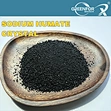


Humic Acid Potassium Granular Fertilizer 65%
Humic acid potassium granular fertilizer is rich in humic acid functional groups with excellent potassium ion adsorption and storage capacity, which can effectively prevent the loss of potassium ions in sandy soils and leachate soils due to water runoff, as well as preventing the fixation of potassium in clay soils. In addition, potassium humate contains low molecular humic acid components such as xanthate, which are able to corrode minerals such as potassium silicate and potassium feldspar, thus slowly decomposing and increasing the release of potassium, further enriching the potassium content of the soil.
_

ITEM | Humic Acid Potassium Granular Fertilizer | |||
Humic Acid (dry basis) | 65% Min | |||
K2O | 10% Min | |||
Moisture | 15% Max | |||
PH Value | 4-6 | |||
Appearance | 0-1mm Crystal | 1-2mm Crystal | 2-5mm Granular | |
Compared with ordinary potash fertilizers, humic acid potassium granular fertilizer has a significantly higher potash utilization rate, which not only improves fertilizer efficiency, but also increases crop yield and improves quality. During long-term use, potassium humate shows excellent water and fertilizer retention properties, and combines the advantages of both inorganic fertilizers and farmyard fertilizers to achieve efficient land use and maintenance. Its unique nutrient release regulation function keeps the fertilizer supply curve stable, avoiding excessive nutrients in the early stage and ensuring that the nutrient supply does not decay in the later stage.
The release rate of humic acid potassium granular fertilizer can also be precisely controlled through physical, chemical and biological technologies, thus realizing the flexible regulation of promoted and slow release. This technology enables the nutrient elements in the fertilizer to remain largely synchronized with the crop's nutrient requirements, thus achieving a state of dynamic balance. Furthermore, the application of humic acid potassium granular fertilizer significantly reduces the risk of soil compaction and water and gas pollution.
_

- In case of soil acidification or salinization.
- When the ground temperature is low in winter, the combination of potassium humate and potassium nitrate can effectively increase the water temperature and promote the growth of crops.
- Using humic acid potassium granular fertilizer before and after the dry and rainy seasons can reduce the damage to crops caused by drought and flooding.
- For crops that need to expand, potassium humate is an indispensable aid.
- When the roots are stunted or prematurely decayed, potassium humate can play a significant effect.
- In the case of soil salinization, sclerosis or insufficient organic matter caused by excessive chemical fertilizers, humic acid potassium granular fertilizer can effectively improve the soil condition.
- If the use of biological fungicide is not effective, try to combine with potassium humate, which can provide the necessary carbon source for the biological bacteria and enhance their efficacy.
- the pursuit of color and surface finish of the crop, be sure to use potassium humate, it can significantly improve the appearance of the crop quality.