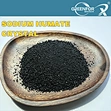


Agriculture Humic Acid Fertilizer 65%
Humic organic fertilizer is an organic fertilizer rich in agricultural humic acid and the amount of inorganic nutrients. Agriculture humic acid is a group of black gelatinous amorphous polymer organic compounds containing carbon, hydrogen, oxygen, nitrogen, sulfur, and other elements. Because of its wide internal surface area, agriculture humic acid has good adsorption, adhesion, colloidal dispersion, and cation exchange amount. Our humic organic fertilizer contains high levels of agriculture humic acid which makes it can Improve fertilizer utilization, stimulate crop growth, and improve soils.

ITEM | HUMIC ACID FERTILIZER | ||
Humic Acid (dry basis) | 65% min | 60% min | 50% min |
Moisture | 10% max | 10% max | 10% max |
PH Value | 4-6 | 4-6 | 4-6 |
Appearance | Flake/Powder/Crystal/Granular | ||
-
Improved Soil Aggregate Structure:
To create an agglomeration structure, humic organic fertilizer can function as a binder, drawing clay mineral ions to it. The procedure involves adhering and combining many clay mineral ions to form microagglomerates, then adhering to multiple microagglomerates to produce big agglomerates. Some of the large agglomerates are then connected to form enormous soil agglomerates. Because of its inherent water resistance and resistance to collapsing under extreme soil moisture, this type of aggregate structure is crucial to the upkeep of the soil aggregate structure. Agglomerate structure is known to be one of the prerequisites for soil water and nutrient retention.
-
Increase Cation Exchange In Soil:
In the clay mineral ions attached agriculture humic acid, the soil colloid on the adsorption of cations is not a simple 1 +1 = 2 but will play an exponential increase in the effect. Agriculture humic acid and clay mineral ions combined with the formation of the agglomerate structure, with more negative charge on its surface, can be adsorbed to keep more cations. The soil can hold onto fertilizer longer, lose less nutrients, and use fertilizer more effectively as its cation exchange capacity rises.
Using potash fertilizer as an example, soil colloids containing humic acid can increase the amount of quick-acting potassium in the soil, encourage the release of insoluble potassium from the soil, and adsorb potassium ions to decrease loss.

During the pepper's seedling, flowering, early fruiting, fruit expansion, and harvest period, every 15 days, the plants are irrigated with humic organic fertilizer. The results demonstrate that, in contrast to simple watering, the pepper leaves have grown thicker, their surface is a vibrant green, their branches and leaves are vigorous, their fruits are bright, and their yield has increased.
-
It has been proved that humic organic fertilizer has the effect of promoting the growth of citrus plants, increasing citrus yield, enhancing citrus resistance, promoting fruit flesh coloring, and improving the quality of citrus, and the effect is remarkable (Soil and Fertilizer of China, 2018).
-
Compared with the control agriculture humic acid fertilizer treatment and traditional fertilizer treatment, the differences in growth traits, single fruit weight, fruit diameter and yield of humic organic fertilizer treatment of bergamot were very obvious, with leaf area of 36.2cm2, centrifugal thickness of 6.23cm, chlorophyll value of 40.3, fruit diameter of 8.2cm, single fruit weight of 169.3g, single-plant yield of 87.3kg, and hectare yield of 104839kg, The soluble sugar content was 14.17% (Modern Agricultural Science and Technology, 2020)
 25kg bags.